 Smart City Africa
 Electrification beyond the grid
Why mini-grids, stand-alone systems and clean cooking belong in the same resilience plan as grid reinforcement.
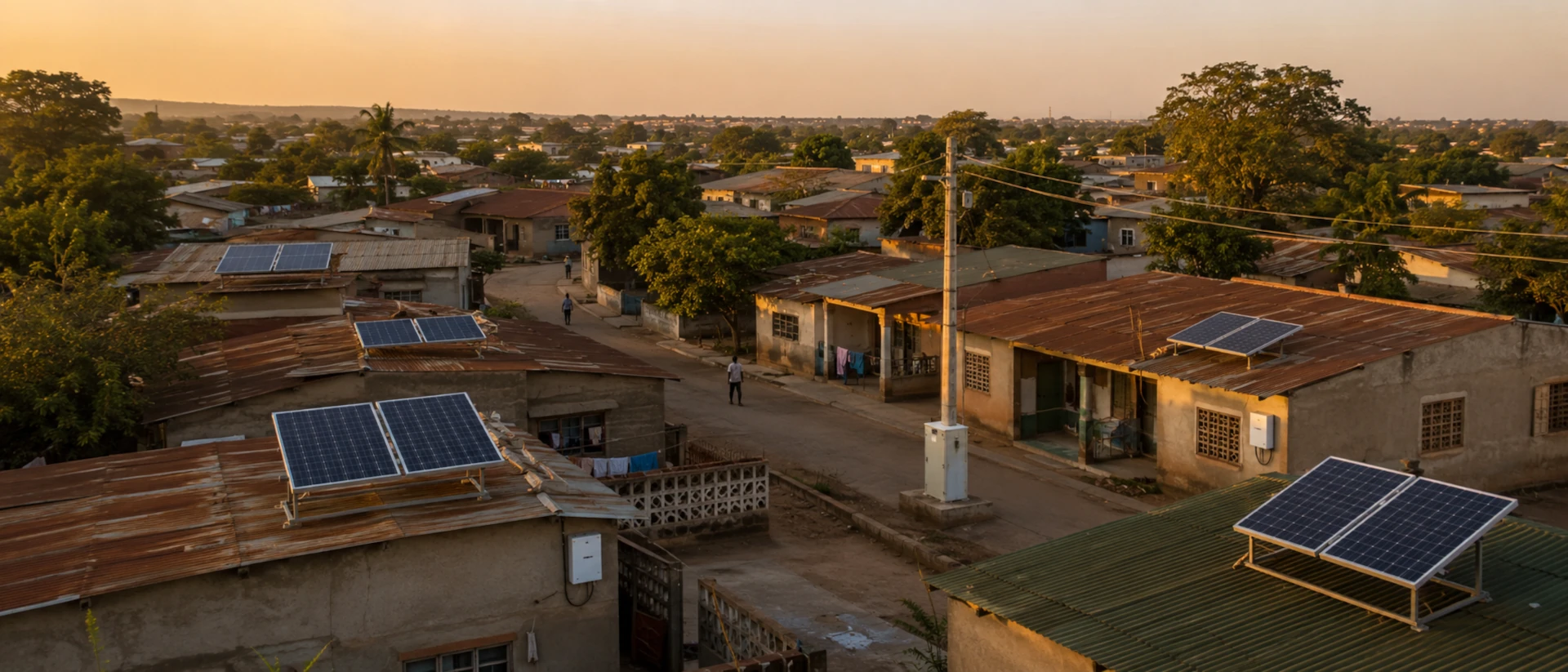
The energy access conversation in African cities has matured past a single binary of “on the grid” or “off it”. The picture that actually serves households, public services and small enterprises is a hybrid one: grid reinforcement where it makes sense, mini-grids and stand-alone systems where it does not, and clean cooking as a parallel system that is too often left out of the headline numbers.
The headline numbers themselves are sobering. The IEA puts roughly 600 million people in Sub-Saharan Africa without electricity access in 2024, and around 960 million without clean cooking access in 2023. Clean cooking carries a measurable health cost — the IEA links household air pollution from cooking fuels to hundreds of thousands of premature deaths per year, concentrated on women and children. The Mission 300 initiative led by the World Bank and African Development Bank aims to bring 300 million additional people on-grid or under reliable distributed systems by 2030; the scale of that target gives a sense of how far current systems still have to go.
For an urban programme, a few design choices recur. Mini-grid economics improve sharply when productive use — cold storage, milling, irrigation, small workshops — is built into the demand curve from the start, rather than treated as a hopeful afterthought. Hybrid power for clinics, schools and water utilities is one of the highest-return resilience moves a city can make: it keeps critical services running through outages, fuel-price shocks and floods, with health outcomes that are immediately visible. And clean-cooking transitions need to be financed and procured as carefully as any other infrastructure investment, because the price-signal alone is rarely enough.
The governance side determines whether private capital actually shows up. Clear regulatory regimes for mini-grids, transparent procurement, predictable connection subsidies and consumer-protection rules are what take a project from a pilot into a portfolio. Without them, capital stays expensive and unevenly distributed, and the access gap closes more slowly than the population grows.
The integrated picture — grid plus mini-grid plus stand-alone plus cooking — is also the picture that holds up in a climate-stressed decade. Treating it as a single resilience plan, rather than four parallel programmes, is the practical version of “people-centred energy”.
Sources
- IEA — World Energy Outlook / Africa Energy Outlook (electricity access in Sub-Saharan Africa, 2024; clean cooking access, 2023).
- World Bank and African Development Bank — Mission 300 initiative.
- Smart City Africa research review (2025), summarising the v2 deep-research report.
Talk to us about applying this in your city.
Which themes fit best is highly city-specific. Tell us a little about the city, the partners involved, and what kind of decision you're trying to make. We'll come back with the right entry point.