 Smart City Africa
 Mobility is an access problem, not a roads problem
Why African urban transport plans should optimise for who can reach what — not for kilometres of new lanes.
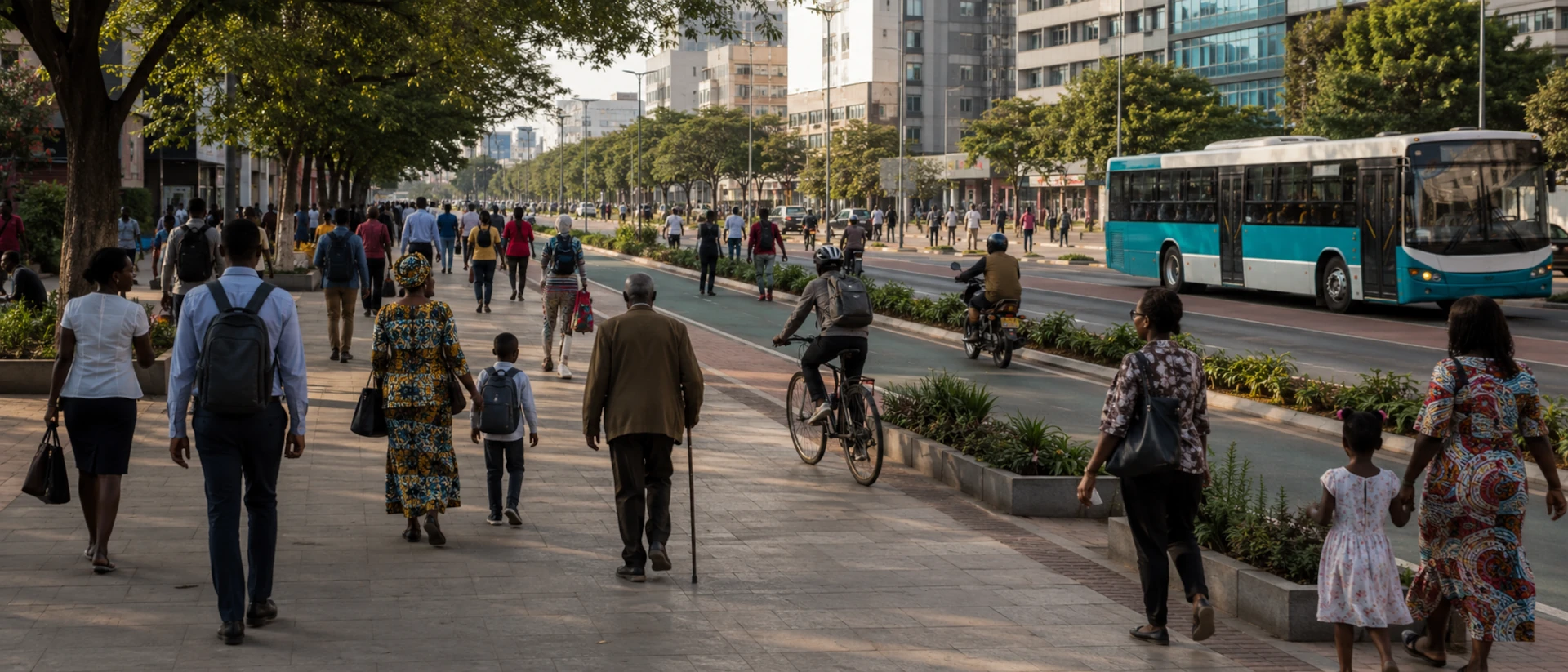
Most urban movement in African cities happens on foot, on two wheels and in informal minibuses, on networks that were never planned for the trip patterns they now carry. The right question for a city is not how many kilometres of new road it can build, but who can reach which jobs, schools, clinics and markets within a reasonable time, at a price they can afford, on services they can trust. That single shift — from infrastructure throughput to access — changes almost every downstream decision.
The numbers are large enough to matter at country scale. UN-Habitat analysis across 188 large African cities indicates that a sustainable mobility scenario, weighted toward public and active transport, could avoid roughly USD 43 billion in infrastructure cost and USD 109 billion in fuel cost relative to business as usual. Concrete corridor results already exist: the World Bank reports that the first phase of the Dar es Salaam bus rapid transit system cut travel times along the corridor by more than half. Both findings point in the same direction — that bus rapid transit, active travel and integrated information do more for access than additional general-traffic capacity.
Road safety should sit alongside access as a steering metric. Pedestrian and two-wheeler injuries on African urban networks are disproportionately high, and they fall hardest on the lower-income households that walk the furthest and use the unsafest streets. A network that is faster but kills more people is not a better network.
The implementation challenge is governance, not technology. Mobility almost always crosses jurisdictional and revenue boundaries; informal minibus and motorcycle services are a critical part of the system, not a problem to be eliminated. Procurement, fare integration and operating models need to protect those livelihoods while raising service quality. Technology — payments, scheduling, real-time information — earns its place once the institutional design is right, not before.
The practical brief for a city team, then, is straightforward to state and hard to deliver: optimise for access and safety, design across formal and informal operators together, and treat new-build infrastructure as a last resort rather than a first answer.
Sources
- UN-Habitat — Sustainable Mobility Scenario Analysis for 188 large African cities, cited in the Smart City Africa research review (2025).
- World Bank — Dar es Salaam Bus Rapid Transit Phase 1 evaluation (corridor travel-time reduction).
- ITDP — guidance on bus rapid transit corridor design and informal-sector integration.
Talk to us about applying this in your city.
Which themes fit best is highly city-specific. Tell us a little about the city, the partners involved, and what kind of decision you're trying to make. We'll come back with the right entry point.