 Smart City Africa
 Waste, circularity and SDG 11.6.1
How collection rates, uncontrolled disposal and informal-sector integration set the realistic ceiling on circular flows in African cities.
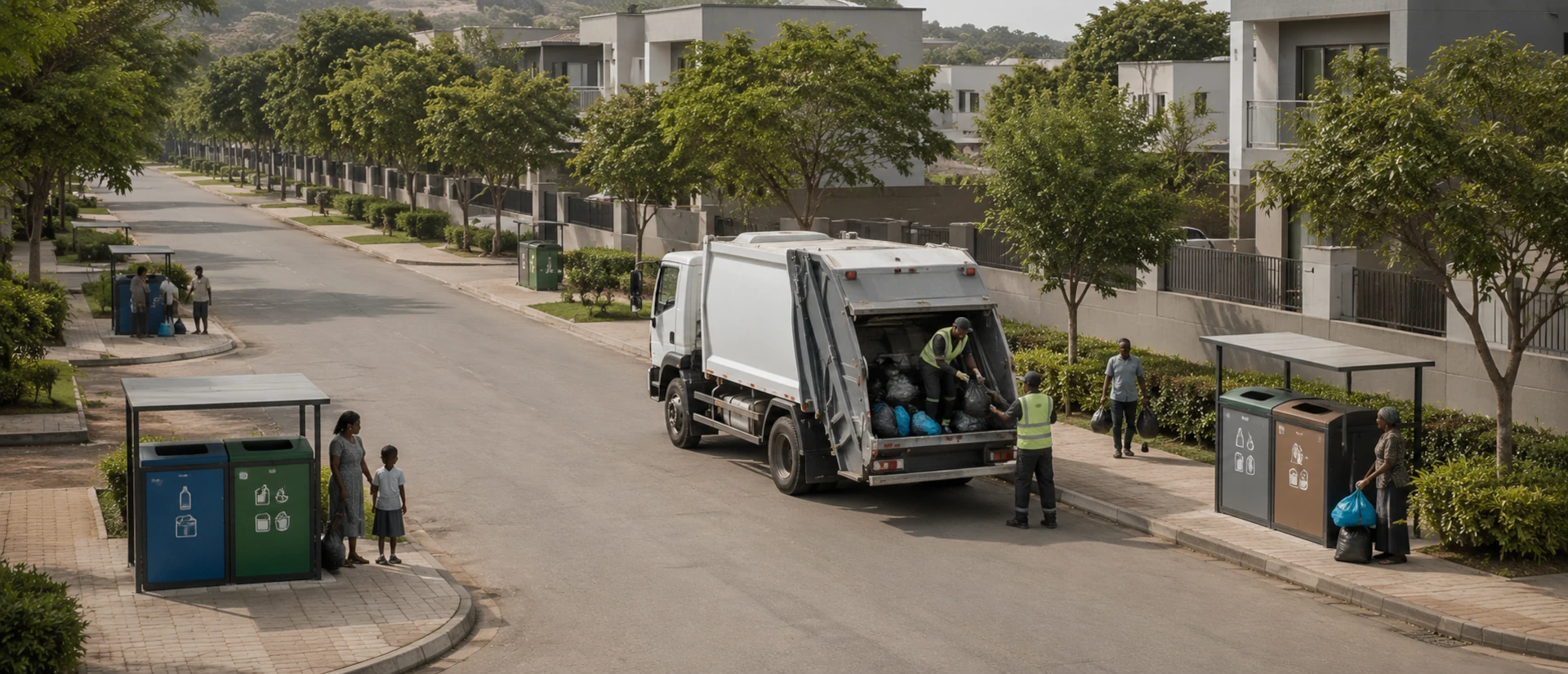
Waste is one of the most measurable urban problems and one of the least well-served. Most African cities know their collection coverage is short of what the population needs, but the public picture rarely makes the gap concrete. The systematic data — from the World Bank, UNEP and the Africa Waste Management Outlook — shows collection rates around 31 percent in some places, more than 90 percent of municipal solid waste landing in uncontrolled disposal in many cities, and only about 4 percent of waste recycled across the continent. Open dumpsites, blocked drains and untreated organics drive flooding, methane emissions and disease outbreaks at the same time.
The SDG 11.6.1 indicator — the share of municipal solid waste regularly collected and adequately final-managed — is the right steering metric, because it forces both ends of the chain into view at once. Collection without final treatment is not progress, and final treatment without coverage is not progress either. Cities that report 11.6.1 honestly tend to make better investment decisions than cities that report headline tonnages.
The realistic ceiling on circularity, in most African cities, is set by two things: how integrated the informal waste sector is, and how seriously source separation and organics handling are taken. Informal waste workers already do a large share of the actual recovery — sometimes the only recovery that happens — and excluding them from the formal system tends to lower performance, not raise it. Recognised contracts, safer working conditions, fair prices for recovered materials and a path to formal participation are the operating reforms that move the needle.
Source separation and organics are the technical levers that follow. Organic waste is the largest fraction in most African urban waste streams; getting it out of mixed disposal reduces methane, landfill volume and disease pressure all at once. Producer-responsibility schemes — packaging, electronics, construction and demolition — close more loops once a baseline collection system is in place.
Done together, these moves turn waste from a cost centre into a local value chain: jobs in collection and processing, lower disposal costs, fewer health and flood damages, and cleaner inputs for construction, agriculture and energy.
Sources
- World Bank — What a Waste 2.0 (global municipal solid waste data, including African urban estimates).
- UNEP — Africa Waste Management Outlook (collection rates, recycling rates, uncontrolled disposal).
- UN — Sustainable Development Goal indicator 11.6.1 (proportion of municipal solid waste regularly collected and adequately final-managed).
Talk to us about applying this in your city.
Which themes fit best is highly city-specific. Tell us a little about the city, the partners involved, and what kind of decision you're trying to make. We'll come back with the right entry point.