 Smart City Africa
 Quality of Life & Inclusion
The outcome layer — measurable wellbeing as the steering metric for urban decisions.
The challenge
Most urban dashboards still privilege growth and infrastructure throughput over outcomes that residents actually feel. The result is plans that look good in aggregate but leave persistent gaps in services, housing, environmental quality, safety and inclusion. Without an explicit outcome layer, decisions tend to optimise for what is easy to count, not for what changes daily life — particularly for women, children, older people, people with disabilities and residents of informal settlements.
Why this matters in African cities now
The international frame for urban development has moved decisively toward people-centred and rights-respecting approaches. The UN Economic Commission for Africa’s quality-of-life work organises wellbeing across nine domains, including basic services and mobility, economy, environment, governance, housing, health and wellbeing, and social cohesion. World Bank / WRI analysis underlines that around 70 percent of African cities face severe climate risks. OECD, AfDB and UNECA work shows urbanisation already explains roughly 30 percent of per-capita GDP growth in Africa — meaning the same urban transformation that drives economic gains also defines the quality-of-life baseline for the next generation. The decision is whether to steer that transformation by outcome, or to discover the gaps after the fact.
How we think about this topic
We treat quality of life as the steering metric, not a side report. The other eight solutions — mobility, energy, telecommunications, responsible AI and operational safety, water and sanitation, waste, governance and the built environment — feed into the same outcome question: who in the city actually lives better, year on year. We frame inclusion explicitly, because gains that are not inclusive tend to be reversible and politically fragile. Climate, environmental and water/sanitation performance are read as quality-of-life domains, not as separate technical files.
What we typically deliver
We help cities and metropolitan authorities define a domain-based quality-of-life dashboard fitted to local realities, run Voluntary Local Reviews against the SDGs, route investment decisions through inclusion-aware criteria, design participation processes that surface the perspectives most often missed, and integrate quality-of-life monitoring with the planning, budgeting and governance workstream. Where possible, we build the dashboard so the same evidence supports city, donor and resident audiences.
Governance and delivery considerations
A quality-of-life lens only steers if the institutions can act on it. We work with city teams on the governance arrangements that make outcomes durable: clear ownership of the dashboard, links to budgeting cycles, engagement formats that reach residents who are usually missed, and protections for the data and people involved. Voluntary Local Reviews are a useful anchor because they tie city ambitions to a recognised global framework while remaining locally meaningful.
How we measure outcomes
We measure progress through residents’ lived experience and a transparent set of domain indicators: access to basic services, housing adequacy, environmental quality, public health, safety, governance trust and social cohesion. Disaggregation by income, gender, age, disability and location is non-negotiable — an average that hides the most-exposed quintile is not a useful steering signal. The steering question is whether more residents, including those who started furthest behind, are actually living better.
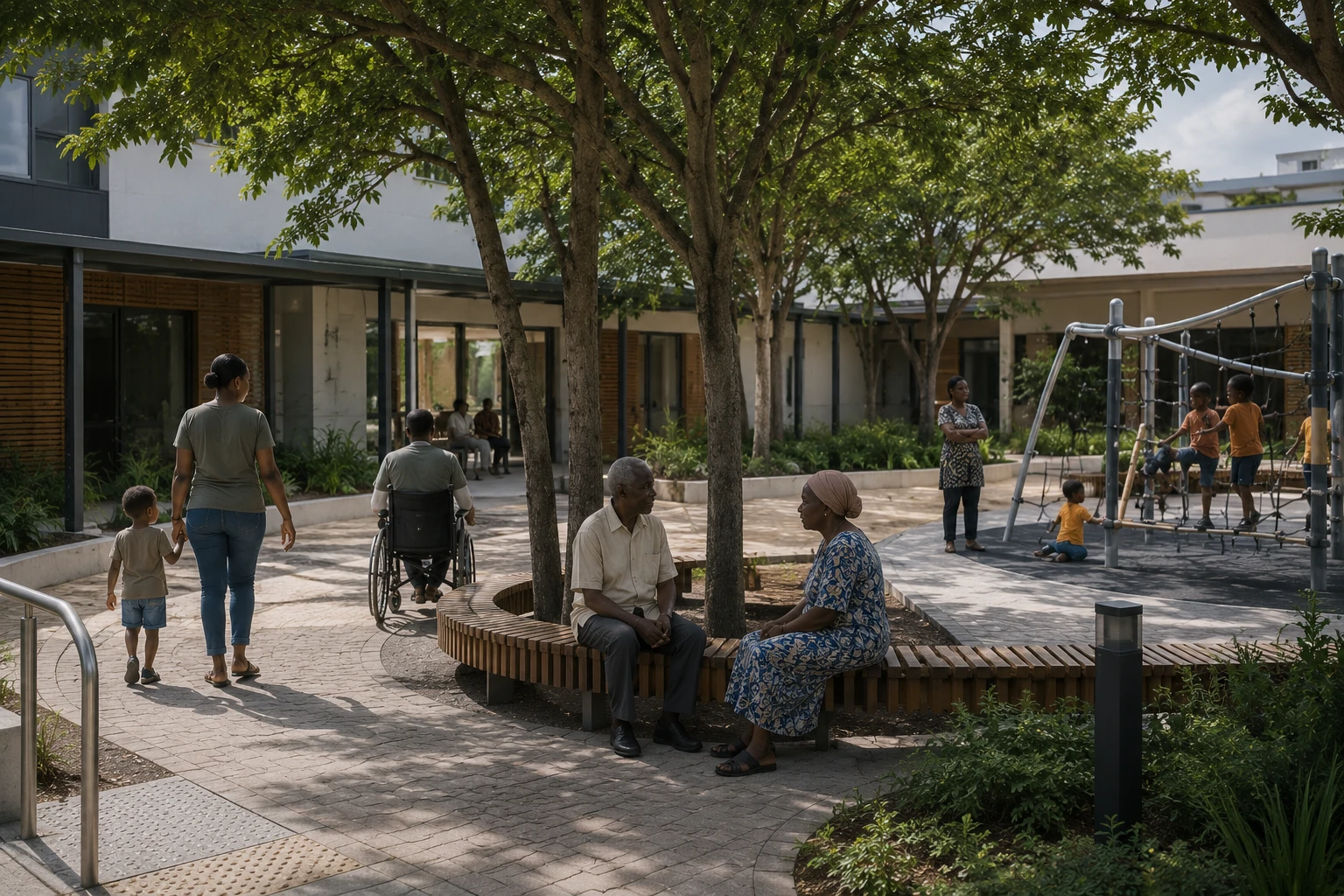
Quality of Life & Inclusion through four lenses.
-
Resilience & Climate
Climate risk, heat exposure and flood loss are quality-of-life outcomes before they are technical metrics. Resilience plans are judged by how they protect daily life for the most exposed.
-
Inclusion & Access
Inclusion — across income, gender, age, disability and location — is the binding constraint on quality of life. The ECA quality-of-life domains explicitly cover basic services, housing, health, governance and social cohesion.
-
Governance & Rights
Voluntary Local Reviews and other accountable monitoring frameworks turn quality of life from a slogan into a steering tool. Rights-respecting governance is what keeps these reviews credible.
-
Economic Impact
Urbanisation in Africa already explains around 30 percent of per-capita GDP growth, according to OECD, AfDB and UNECA work. Quality-of-life gains and economic gains compound when planned together.
Talk to us about quality of life & inclusion.
Which themes fit best is highly city-specific. Tell us a little about the city, the partners involved, and what kind of decision you're trying to make. We'll come back with the right entry point.