 Smart City Africa
 Technology & Components
Vendor-neutral building blocks for water, sanitation and operational systems — with their typical applications, limits and operating requirements. An orientation page for cities, utilities, donors and private partners planning around standards, operations and procurement, not a product catalogue.
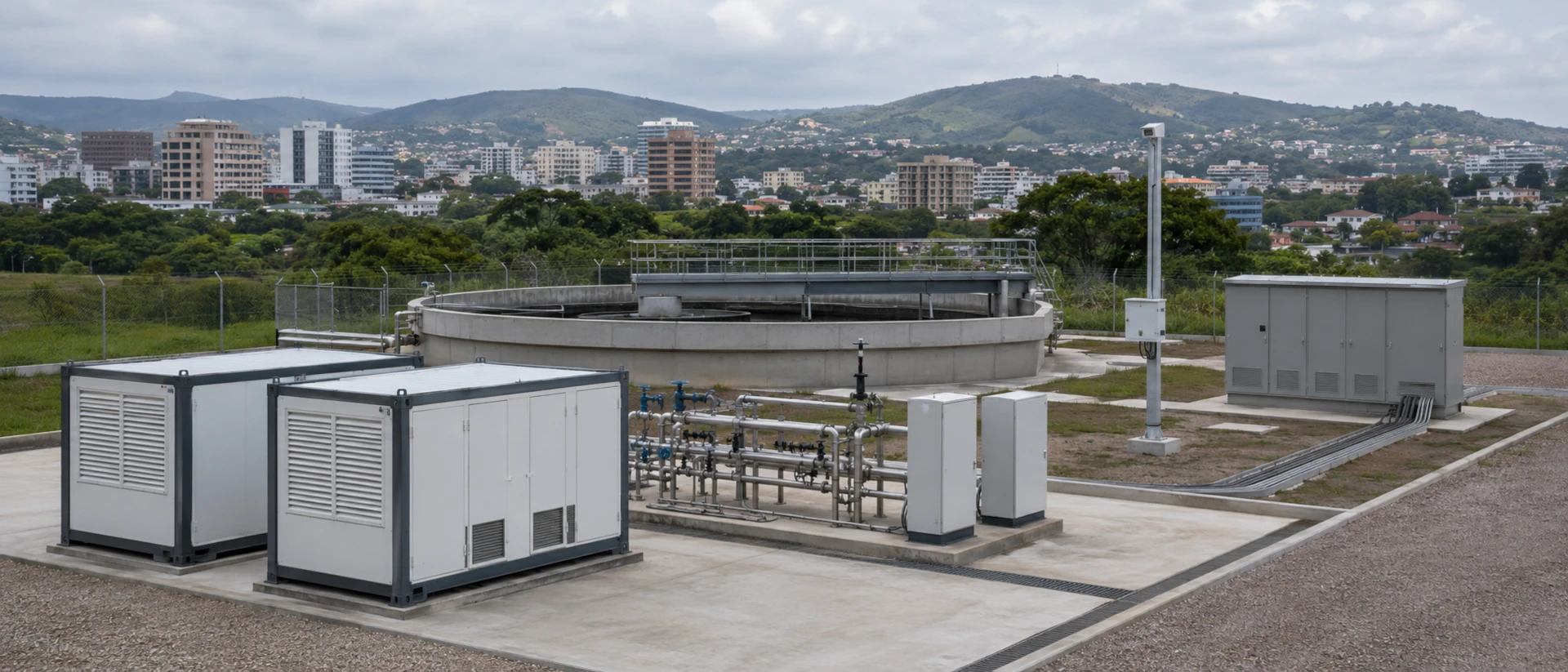
Standards, operations and procurement first — not a product list.
Decisions about water and sanitation technology in African cities live or die on operating capability, monitoring, procurement guardrails and public-health compliance. This page describes the technology categories that recur in our work — neutrally — so cities, utilities, donors and private partners can place a real-world option against a clear context, instead of working from a product brochure.
Performance ranges, certifications, vendor and country-specific suitability are project-specific and remain unspecified here until they are verified per engagement. Working sources are the WHO Guidelines for Drinking-water Quality, WHO Water Safety Plans, WHO Sanitation Safety Planning, the IWA Digital Water frame, and peer-reviewed reviews of treatment technologies in developing-country contexts. National standards apply on top.
Recurring technology categories.
Each block is described in three frames: typical use; limits and constraints; operating requirements. The categories often combine within a single project — they are tools, not menu items.
-
Membrane bioreactors (MBR)
- Typical use
- Treatment of municipal or industrial wastewater where high effluent quality and a small footprint matter — particularly when the treated water feeds reuse pathways (irrigation, industrial, indirect potable).
- Limits
- Capital and operating costs are typically higher than conventional activated sludge. Membrane fouling, cleaning regimes and replacement intervals are real operational constraints. Comparable continent-wide performance data for African contexts is unspecified in the primary sources we trust.
- Operating requirements
- Requires trained operators, predictable chemicals supply, energy continuity, and an O&M model with documented spare-parts logistics. Lab testing remains essential — membranes do not replace verification.
-
Sequencing batch reactors (SBR)
- Typical use
- A flexible biological treatment option for small to medium municipal and industrial flows, particularly where loading varies through the day or week.
- Limits
- Sludge handling, energy consumption, and operator skill are non-trivial. Sensitive to shock loads of toxic compounds. Performance figures are project-specific.
- Operating requirements
- Cycle times, dissolved oxygen control and sludge wasting must be tuned to the local load profile. Telemetry helps but does not replace a maintenance regime.
-
Chlorination and UV disinfection
- Typical use
- Core disinfection building blocks at the end of drinking-water treatment trains, in distribution residual maintenance, and in reuse polishing.
- Limits
- Both have known limits — chlorination requires upstream turbidity control and produces disinfection by-products; UV requires sufficient transmittance and provides no residual. Typically combined with upstream treatment, not used alone.
- Operating requirements
- Chemical handling, dosing control, residual monitoring and lamp / sensor maintenance are recurring O&M tasks. Lab confirmation of microbial targets is required, not optional.
-
Desalination
- Typical use
- Regionally relevant where freshwater scarcity and saline source water make the energy and cost trade-off defensible.
- Limits
- Energy-intensive and operationally demanding. Concentrate (brine) management has its own environmental and regulatory profile. Suitability is highly site-specific and must be assessed against the local energy plan and source-water characterisation.
- Operating requirements
- Pre-treatment, membrane integrity, energy recovery, and concentrate disposal all need an operating regime. Cross-link with the [Energy](/solutions/energy) plan is mandatory, not optional.
-
Package plants
- Typical use
- Pre-engineered treatment units suitable for new districts, peri-urban growth, individual institutions or transitional contexts.
- Limits
- Field reports indicate that package plants often fail not on technology but on O&M, spare-parts logistics, and integration into the wider utility processes. Reliability hinges on the operating model around them.
- Operating requirements
- Spare-parts logistics, vendor-neutral training, and integration into the utility reporting and tariff regime decide whether the asset is still working five years later.
-
Mobile and emergency units
- Typical use
- Containerised or skid-mounted treatment for emergency response, construction sites, temporary settlements or specialised industrial flows.
- Limits
- Designed for short to medium-term operation; not a substitute for permanent infrastructure. Spare-parts and chemicals supply chains can be the binding constraint.
- Operating requirements
- Define a clear handback or scale-up route from the start so the unit does not become a permanent shadow asset outside the formal operating regime.
-
Sensors, telemetry and SCADA
- Typical use
- Visibility across raw-water status, treatment process, distribution and customer-side complaints. Improves alarming, dispatch and operational control across centralised and decentralised assets.
- Limits
- Sensors and dashboards do not replace accredited laboratory testing or governance. Drift, calibration and cybersecurity are real failure modes. The IWA Digital Water frame and WHO GDWQ remain the working baselines for which signals matter.
- Operating requirements
- Calibration regimes, data validation, alarm thresholds and operator training are part of the system. Open data formats and exit / portability protect against vendor lock-in.
What this page is not.
- Not a vendor recommendation. No supplier is recommended, ranked or endorsed on this page. Implementation partners are selected per project, on documented procurement criteria.
- Not a performance promise. Continent-wide, comparable performance data for many of these categories in African contexts are unspecified in the primary sources we trust. Project-specific data has to be generated through pilots.
- Not a reference list. Past projects, certifications, supply-chain depth and service coverage are not advertised here. Where relevant, they are documented in the engagement brief, not on a public page.
- Not a substitute for the standards layer. WHO GDWQ, WHO WSP / SSP, national drinking-water and discharge regulations, ESIA / RAP requirements and procurement guardrails sit upstream of any technology choice.
Documented basis before deployment.
Lawful and safe operation of any of the categories above depends on a project-specific compliance basis: WSP for drinking-water systems, SSP for sanitation and reuse, the WHO Guidelines for Drinking-water Quality, national or city drinking-water, discharge and reuse standards, effluent permits, sludge-handling rules, worker safety, chemicals management, and noise / odour limits. Local standards and permit conditions vary by country and by site and must be confirmed up front, not assumed.
Where these building blocks are applied.
- Water & Sanitation
How centralised, decentralised and modular options combine into a managed service.
- Data-Driven Planning & Urban Governance
Procurement, interoperability and accountability around technology choices.
- Energy
Resilient power for treatment plants, telemetry and reuse infrastructure.
- Approach
People-centred, evidence-based delivery — the wider operating frame.
Talk to us about technology fit and operating model.
Which themes fit best is highly city-specific. Tell us a little about the city, the partners involved, and what kind of decision you're trying to make. We'll come back with the right entry point.