 Smart City Africa
 Agriculture & Regional Food Systems
Industrial-scale agrifood supply for African cities — mechanised production, cold chain, processing and outgrower integration as one connected pipeline.
The challenge
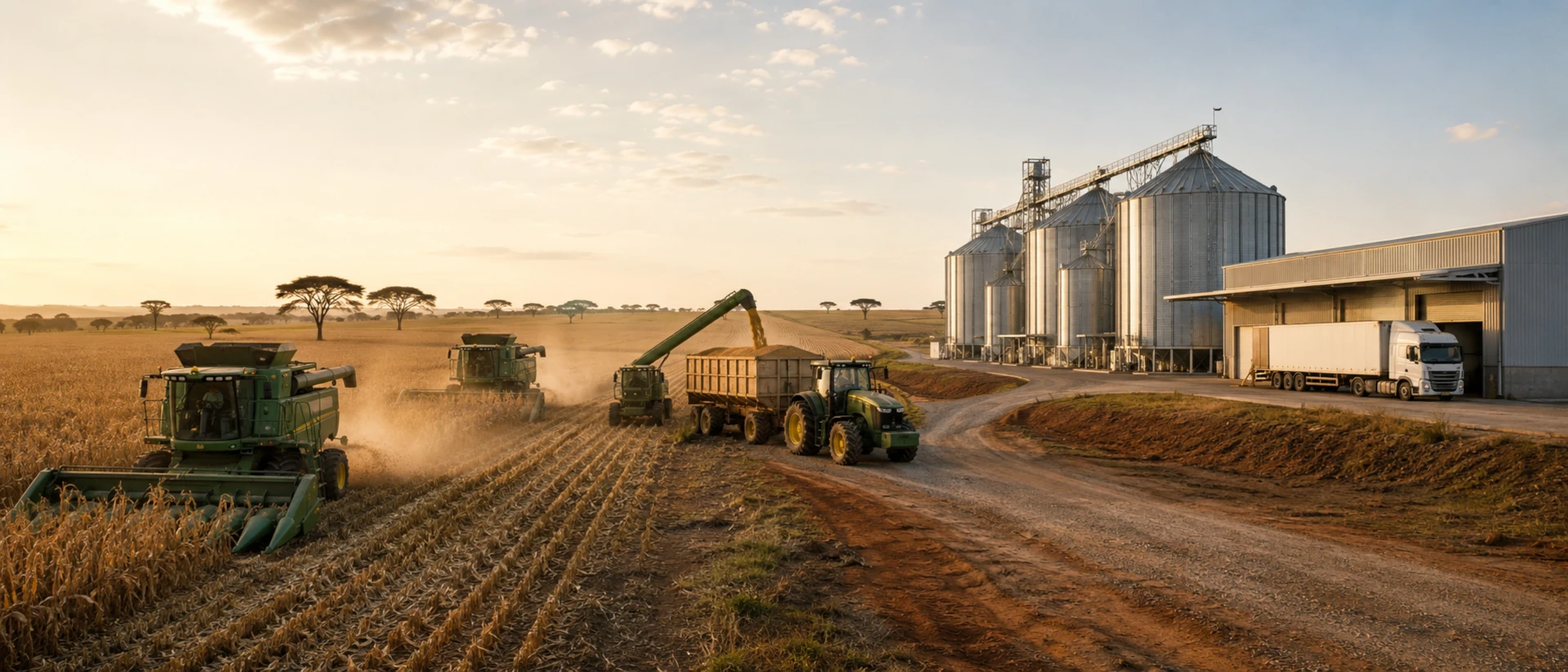
African cities still import a large share of the food they consume — staples, dairy, processed goods and out-of-season perishables — because the supply pipeline behind them is fragmented, under-capitalised and high-loss. The honest reframe is to stop treating agriculture as a rural development theme and to start treating it as the supply layer behind every city: mechanised production, irrigation at scale, aggregation and cold chain, processing close to production, and a contracting layer that links smallholders to industrial buyers. Pure smallholder-first programmes do not move the import bill; pure estate-style industrialisation does not survive politically. The viable thesis is industrial scale-up with structured smallholder integration.
Why this matters in African cities now
The market case is direct. The World Bank estimates that Africa’s food market was around USD 313 billion in 2013 and could triple by 2030 if infrastructure, trade and agribusiness investment lands. Agribusiness already represents one quarter to one third of off-farm work, and the African Development Bank reports that agriculture still accounts for just over 60 percent of jobs across the continent. Productivity gaps are concentrated in mechanisation and water: only about 5 percent of Sub-Saharan agricultural land is equipped for irrigation, and the World Bank documents that the 7 million irrigated hectares already deliver around 38 percent of total output — the leverage of mechanised water is enormous and largely untapped. On the loss side, FAO estimates that post-harvest loss cuts the income of around 470 million smallholders globally by about 15 percent, and that developing countries could save 144 million tonnes of food a year with developed-country cold-chain infrastructure. The combined import-substitution, jobs and food-security upside is in the same investment thesis. The inclusion thesis is just as direct: FAO 2025 puts women at about 49 percent of the agrifood-systems workforce in Sub-Saharan Africa with 76 percent of working women employed in the sector, and the World Bank documents 13 to 25 percent yield gaps for women farmers driven by unequal access to land, tools and markets — gaps that an outgrower-integrated industrial pipeline can structurally close.
How we think about this topic
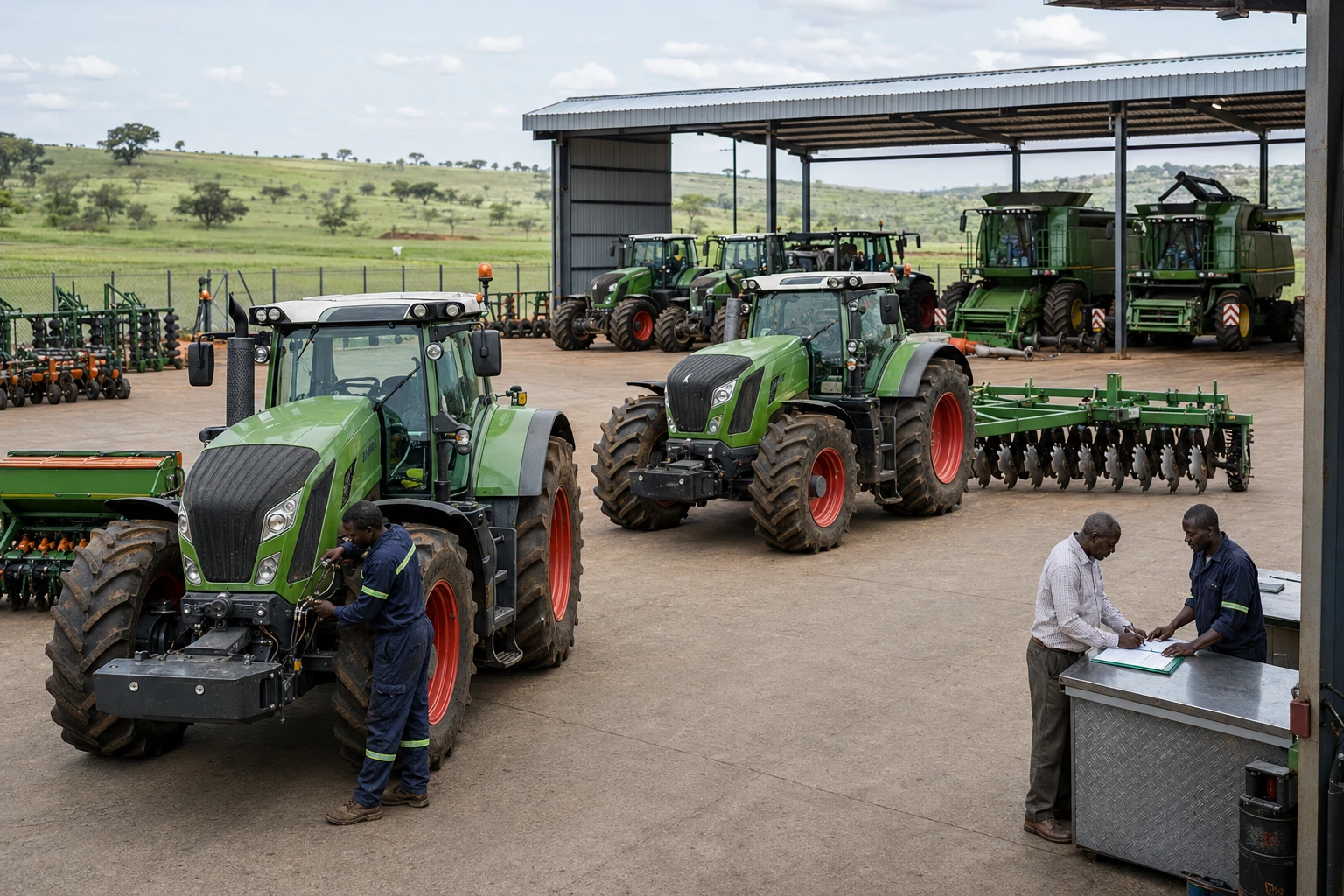
We treat African agriculture as an industrial supply pipeline that has to be built, capitalised and governed — with smallholders integrated as suppliers, contract growers and producer-organisation members rather than as the project’s end-users. The starting point is a value-chain map for one or two crops: which urban demand is captured by imports today, where the production base sits, what mechanisation, water, storage and processing is missing, and where the contract architecture (off-take, outgrower terms, mechanisation rental, traceability) needs to be built. From that map the design space opens — mechanised production, irrigation at scale, aggregation and cold chain, processing close to production, contract structures, financing and governance — sequenced by what unblocks supply volume and import substitution fastest. Smallholder integration is a structural design parameter inside that pipeline, not a separate workstream.
Building blocks at a glance
Most viable programmes combine several:
- Mechanisation services. Tractors, planters, sprayers, combine harvesters, threshers and post-harvest equipment delivered through service-hub and rental models — the model that scales fastest and reaches both estate and outgrower production. FAO’s mechanisation evidence supports value-chain-wide service models over single-asset transfer.
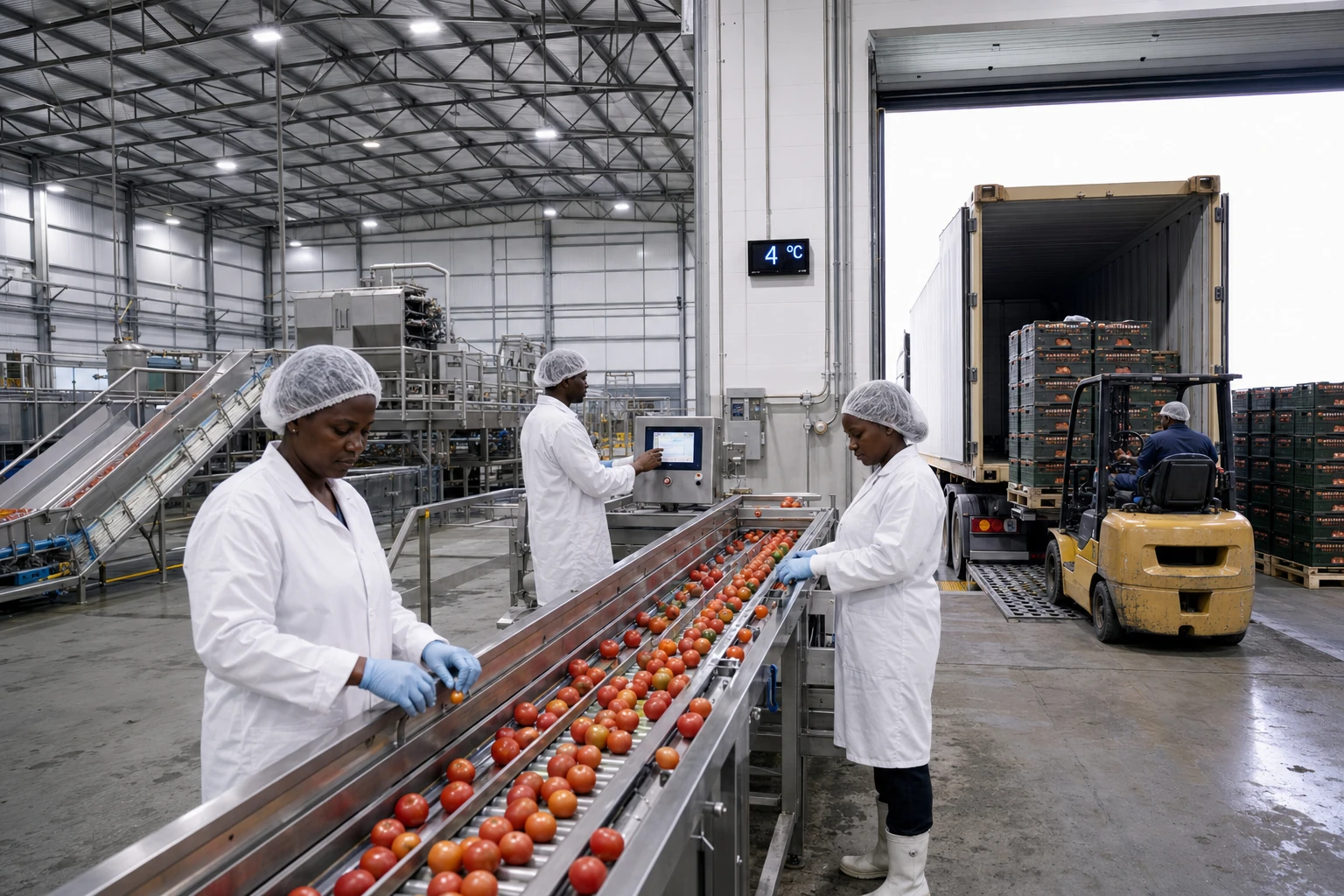
- Storage, cold chain and reefer logistics. Industrial-scale aggregation centres, cold rooms, blast freezers, controlled-atmosphere storage and refrigerated road transport. Strengths: lower post-harvest loss, longer market reach, food-safety compliance, stable contract supply. Constraints: energy reliability, capital cost and integration with the procurement layer.
- Irrigation at scale. Centre-pivot, drip and solar-pump systems sized for commercial fields and outgrower blocks alike. Strengths: yield, climate buffering and a structural shift from rain-fed to managed water. Constraints: water rights, abstraction limits, hydrological assessment and equipment financing.
- Processing and value addition. Sorting, grading, primary processing, packing and basic transformation close to production — where most of the import-substitution margin and the off-farm jobs sit.
- Seed systems. Integrated public, private and community seed channels that move quality varieties through formal and farmer-managed routes. FAO recommends this integrated frame over a single-channel approach.
- Outgrower and aggregation contracting. Productive alliances and outgrower schemes that link smallholders to industrial buyers with documented price, quality and volume terms — the contract layer that decides whether the pipeline is socially and politically durable.
- Agroecology and soil health. Practices that protect soil, water and biodiversity while keeping yields stable; assessed alongside, not against, productivity-led options.
- Digital extension and traceability. Mobile advisory, weather and market information, on-farm sensors, aggregator dashboards and traceability systems for food-safety and export compliance. The peer-reviewed evidence on digital agriculture in Sub-Saharan Africa is real but cautious — connectivity, digital literacy, affordability and gender gaps mean technology is a tool inside a delivery model, not a substitute for one.
The right combination is sequenced per region and per value chain; the most defensible plans start with one or two anchor investments — typically a mechanisation service hub, an aggregation-and-cold-chain centre, or a processing line — and scale through procurement, productive alliances and donor finance.
Anchor delivery: where to start
For governments, agribusiness investors and DFIs entering this market, the most defensible starting move is an anchor investment that picks one value chain, one region, one binding constraint — and one off-take buyer. That can be a regional mechanisation service hub serving estate and outgrower production with documented rental and maintenance economics; a cold-chain and aggregation centre wired to a city’s public-procurement demand for schools, hospitals or food-assistance programmes; or a processing line that captures import-substitution margin in a specific category — dairy, edible oils, processed grains, frozen perishables. Each of these creates a measurable supply, loss and contract-volume signal — and a credible base for follow-on procurement, PPP or DFI scale-up. We help cities, ministries and investors draw the value-chain map, set the anchor scope, line up financing routes — sovereign, donor, DFI, commercial — and build the operating model around mechanisation rental, outgrower contracting and aggregator linkages.
Governance, compliance and delivery considerations
Industrial agrifood investment crosses rural, peri-urban and urban governance, and the regulatory layer has to be explicit from day one. Land-tenure rules, water rights, food-safety standards, sanitary and phytosanitary regimes, seed certification and procurement rules vary across Africa and stay project-specific — they cannot be assumed from a continental average. We work with cities, regional authorities and national ministries to verify land status and customary rights, water-source and abstraction permits, food-safety and traceability requirements, and the procurement route — sovereign, donor-financed, PPP, framework contract or productive alliance. The outgrower-integration layer — contract terms, women’s participation, smallholder representation in producer organisations and grievance channels — is designed in from the start, in line with World Bank evidence that producer-buyer linkages and third-party finance work better than reliance on project subsidy alone. The technology layer is documented vendor-neutrally on the Technology & Components page; cross-links to Water & Sanitation, Waste & Circular Economy and Data-Driven Planning & Urban Governance keep irrigation, organics and traceability connected to the rest of the city-region plan.

How we measure outcomes
We measure agrifood pipeline work against supply, loss, jobs and inclusion — not against installed equipment alone: share of urban demand met by regional production versus imports across the targeted value chain; post-harvest-loss reduction; aggregated supply volume against contract; storage and cold-chain uptime; mechanisation utilisation hours per asset; outgrower-contract coverage and price realisation; women’s and youth participation in producer organisations and value-chain roles; and food-safety and traceability conformance. Continent-wide thresholds are unspecified — they are localised per country and value chain — but the direction-of-travel question is consistent: did the pipeline deliver more food into the city at lower loss and fairer terms than imports could, and can it keep doing so under climate, demand and trade-policy stress?
Agriculture & Regional Food Systems through four lenses.
-
Resilience & Climate
Industrial-scale food production is climate-exposed by default. Mechanised irrigation, on-farm and aggregator-level water storage, climate-adapted varieties and a working cold chain are how mechanised farms, processing lines and reefer logistics keep delivering through droughts, heat and erratic rainfall. The World Bank reports that across Sub-Saharan Africa only about 7 million of 175 million cultivated hectares are irrigated, yet they generate roughly 38 percent of total agricultural output — the productivity case and the climate case are the same investment.
-
Inclusion & Access
Industrialisation without integration fails politically and commercially. Outgrower schemes, productive alliances and mechanisation-rental models are how an industrial pipeline absorbs the smallholder base it depends on. FAO 2025 figures show women are about 49 percent of the agrifood-systems workforce in Sub-Saharan Africa, and 76 percent of working women in the region are employed in agrifood systems — yet in 28 of 33 countries with data, men are more likely than women to own land or hold secure tenure, and World Bank evidence shows women farmers in six African countries produced 13 to 25 percent less per hectare than male counterparts. Land security, contract terms, mechanisation access and producer-organisation governance for women are commercial design parameters, not optional CSR.
-
Governance & Rights
Industrial agrifood investment lives or dies on the rule book. Land tenure, water rights, food-safety standards, seed-certification regimes, sanitary and phytosanitary rules and procurement law vary by country and are not uniform across Africa. A defensible programme starts with land status and customary rights, water-source and abstraction permits, food-safety and traceability requirements, and a clear procurement route — sovereign, donor-financed, PPP, framework or productive alliance. Producer organisations, women farmers, local authorities and grievance channels belong in the design from day one — not because of soft compliance, but because they decide whether the asset is still operating ten years later.
-
Economic Impact
African cities import a large share of their food today, and the import bill is rising with population. The World Bank estimates that Africa's food market — around USD 313 billion in 2013 — could triple by 2030 with investment in infrastructure, trade and agribusiness, and that agribusiness already accounts for one quarter to one third of off-farm work. The African Development Bank reports that agriculture still represents just over 60 percent of jobs across the continent. FAO further estimates that post-harvest food loss cuts the income of 470 million small-scale farmers globally by about 15 percent, and that developing countries could save 144 million tonnes of food each year with cold-chain infrastructure comparable to developed economies. Industrial scale-up captures both the import-substitution margin and the jobs.
Talk to us about agriculture & regional food systems.
Which themes fit best is highly city-specific. Tell us a little about the city, the partners involved, and what kind of decision you're trying to make. We'll come back with the right entry point.