 Smart City Africa
 Smart cities are co-designed, not delivered
A peer-reviewed study in Westbury, Johannesburg, asked residents what they actually wanted from "smart city" technology — and how. The answers are concrete, modest, and a sharp contrast to the six-year-old promise of Lanseria.
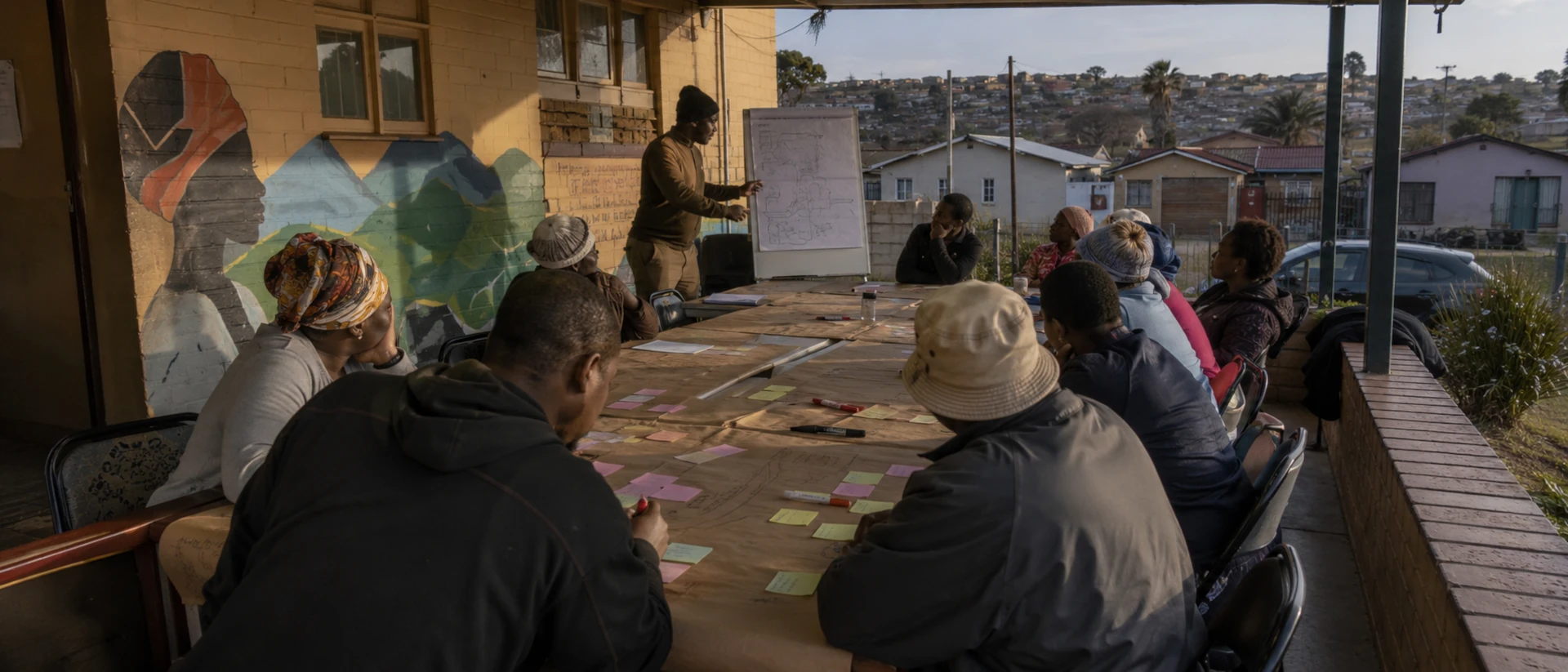
A peer-reviewed study in Westbury, a working-class neighbourhood west of central Johannesburg, asked residents what they actually wanted from “smart city” technology — and got concrete, modest answers. Six years into the Lanseria Smart City promise, with 350,000 to 500,000 future residents announced and a partial fence on the ground, the contrast between the two approaches has stopped being abstract.
What Westbury asked for
Researchers Rennie Naidoo, of the Wits School of Business Sciences, and Terence Fenn, of the University of Johannesburg, brought a method called Participatory Futures into Westbury. The neighbourhood was shaped by apartheid-era spatial designation, has high unemployment and entrenched gang violence, and lives with chronic power cuts. It also carries a deep musical and artistic tradition, which residents named as a foundation, not a footnote.
The technology residents asked for was specific. Smart surveillance, yes, but locally controlled — cameras and sensors managed by community members residents trusted, not by, in Naidoo’s framing, “some distant authority”. Solar hubs that could keep homes, schools, and small businesses running through blackouts, treated as basic infrastructure rather than a green luxury. Tech-enabled community centres. A cultural precinct anchoring the existing music heritage. Recycling kiosks. Augmented-reality tools that could carry local history forward through public art.
The values underneath, in Naidoo’s words: safety, creativity, shared power, resilience. Not a futuristic skyline — daily tools that fit daily life.
The Participatory Futures method
The Participatory Futures method, published by Naidoo and Fenn in the Journal of Community Informatics, adapts a model originally built to optimise profitability inside large corporations — Design Science Research — and strips out the corporate problem-frame. Residents do not advise consultants; they articulate the problem and the future.
In practice the method is workshop-based: guided imagination of future neighbourhoods, supported by structured prompts and shared visual artefacts, with the explicit aim of producing useable design requirements. The output is not a wishlist. It is a specification.
The choice of word matters. Smart-city procurements typically begin with a vendor RFP and a feature set. The Participatory Futures method begins with residents and a set of needs from which the RFP is then derived. The order is the entire argument.
The method’s limits are not hidden. The Westbury study covers one neighbourhood and one workshop series; the results generalise to comparable contexts but are not a quantitative mandate. Workshop participation produces its own selection bias. And the path from a vision document to a procurement spec is methodologically non-trivial in itself. None of this weakens the central claim — but it should temper how the result is invoked.
The Lanseria contrast
Six years after President Cyril Ramaphosa announced the Lanseria Smart City in his 2020 State of the Nation Address — a “truly post-apartheid city” for 350,000 to 500,000 people by 2030, 5G-ready, a green-infrastructure benchmark for the continent — the visible site shows a partially completed fence along Ashenti Road, some new solar streetlights, and a R320-million water treatment plant that broke ground in October 2024.
The Gauteng Growth and Development Agency, in January 2026, described the project as being in the “pre-designation phase”. A BusinessTech site visit in the same period reported “open veld and informal settlements”. Independent reviews of the 2026 State of the Nation read Lanseria as one of several infrastructure dreams that “remain conceptual”.
The point is not that Lanseria is dishonest. Real infrastructure — the water treatment plant — is being built, and the master-plan documents take inclusion seriously on paper. The point is the procurement sequence. Lanseria began with a vision delivered from the top — population targets, technology grades, ambition — and is slowly assembling the substrate that would, eventually, hold a city. Westbury began with people who already live somewhere, asking what they need. Both approaches require time and money. Only one is verifiable along the way.
What this changes for procurement
The Westbury result has direct implications for how digital programmes get scoped in African urban governance.
- The Analysis phase of any smart-city project should produce a resident-articulated needs document before a vendor brief is written. Participatory Futures is one method to do this; others exist. The discipline matters more than the brand
- Vendor selection criteria should include how well the proposed solution maps to that needs document, not only its feature parity against a generic smart-city specification
- Performance metrics should include resident-controlled outcomes, not only operator-controlled ones. “Cameras managed by community” is a different metric than “cameras installed”
This is not a rejection of large infrastructure. Water treatment plants and rail spines are necessary and demand scale. It is a rejection of the assumption that scale itself is the smart-city argument.
A method with a lineage
The Westbury study sits in a small but growing international lineage. In Cape Town, the Play Khayelitsha initiative used role-playing games to surface resident priorities — safety, mobility, dignity. In Medellín, Colombia, a generation of governance reform substituted participatory consultation for top-down planning in transport, public space, and education, and produced internationally cited urban transformations.
What links these cases is not the technology. It is the position of residents in the decision sequence — early, not late; constitutive, not consultative.
Naidoo, in the Wits report, is direct about the budget arithmetic this produces. “We may not have the budget for grand sweeping projects such as Lanseria,” he is quoted as saying, “but the cumulative effect of small, transformative projects within communities can have a dramatic impact.” The trade is real, and on the evidence available so far, it favours co-design.
For the governance architecture that turns participation into procurement, see Data-Driven Planning & Urban Governance.
Talk to us about applying this in your city.
Which themes fit best is highly city-specific. Tell us a little about the city, the partners involved, and what kind of decision you're trying to make. We'll come back with the right entry point.